| |
- 1 Dr. Steen Eiler Rasmussen, Danish architect and author (1898-1990) successfully associated the concept of the 'scattered city' with London.
Professor of Architecture at the Royal Danish Academy of Fine Arts;
Visiting Professor at M.I.T, Yale, Pennsylvania and California at Berkeley in the 50ies.
Chairman of the Copenhagen Regional Planning Committee (EGNSPLANKONTORET) 1945-1960
Online (.ram file):
Lessons from modern urban design at The Metropolitan Future Conference on the Metropolitan Future (lecture 1963, Berkeley, Calif.). http://www.lib.berkeley.edu/
- 'London, The Unique City' by Steen Eiler Rasmussen, published by The MIT Press, Cambridge, Massachusetts (Revised Edition) - 1982 (original edition in Danish, London - 1934)
2 'AN ESSAY ON LONDON NEW TOWNS Modern and Ancient: A New and More Happy Ending but No End', 1978 (Appendix, page 405)
3 In his essay Rasmussen discusses urban planning efforts during and after WW II (resulting in the satellite cities [New Towns] of Greater London) as an historic parallel: » […] The idea of developing London by laying out 'New Towns' outside the urban district is not all a new one but a traditional method from the seventeenth and eighteenth centuries, forgotten in the nineteenth. « (page 440)
4 (page 441)
5 [ » Proclamation against NEW BUILDINGS and INMATES. « ] by Queen Elisabeth I [ » Given at Nonesuch, the 7th day of July, 1580, in the twenty-second year of her Majesty's reign. « ]
[pages 442, 67 ff.]
» After [a] drastic description of the bad housing conditions it is declared, that: "her maj., by good and deliberate advice of her council, and being also thereto moved by the considerate opinions of the lord mayor, aldermen, and other the grave wise men in and about the city, doth charge and strictly command all manner of persons, of what quality soever, they be, to desist and forbear from any new buildings of any house or tenement within three miles from any of the gates of the said city of London, to serve for habitation or lodging for any person, where no former house hath been known to have been in the memory of such as are now living; and also to forbear from letting or setting, or suffering any more families than one only to be placed, or to inhabit from henceforth in any house that heretofore hath been inhabitated." […] Breaches of the regulations about one family in each house involves penalty of imprisonment. « (page 68)
For the entire proclamation see: 'The Beauties of England and Wales; or Delineations, Topographical, Historical, and Descriptive.' by Edward Wedlake Brayley [and others], published in London 1814 http://books.google.at/ [page 50 to 52]
or
in John Strype's 'A SURVEY OF THE CITIES OF London and Westminster' […]
6 (page 459, 460)
» The houses were as a rule constructed as purlin houses. The 16,5 foot facade corresponded to a roof timber of 16 feet and twenty two 9 inch bricks. In other words, good, common measurements. « (page 461) See: London Metrology
7 According to Horwood's map from 1799 (page 460)
Rasmussen's [preconceived] observation is ultimately depending on Horwood's spatial classifications for his map, which is scaled in chains! [ » Scale of 20 Chains or a quarter of a Mile. « http://www.motco.com/]
Nonetheless, when looking at Horwood's maps closely [which are sufficiently accurate to disprove Rasmussen] it is all obvious that Georgian houses came in different sizes and shapes throughout London. Very much like today, outlines for commercial architecture were [pre]determined by marketability (size, typology), technological limitations (span width, foundation, economical ways of construction), legal requirements, and [sadly] very last by site. Well-tried and successful developments are and were simply copied and "transfigured" to match a given area … [merely assuming that planning procedures haven’t changed much since then.]
But it is also true, even in a metric CAD practice (less focused on notions of integer divisions at the very core of old English units) that "nice measurements" complying to grid/ratio/numerology/systems are preferred by planers [and their historians]. See: London Metrology
8 (pages 460-461)
9
» The English house from this period [1780] is in accordance with the principles of Industrialism [… it] is not an individual work of art, but a refined industrial product brought to perfection through constant selection during repeated serial construction. « (page 224)
» People would choose a house as they nowadays choose a car. « (page 229)
- Sdoutz 2007
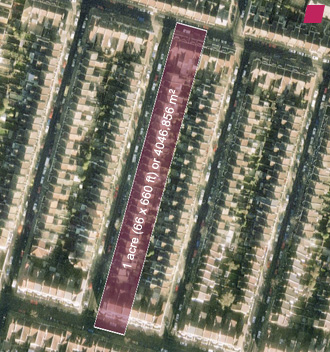
Img. _01 Coxwell Road (Eltham, Greater London, UK), Google Earth 2007
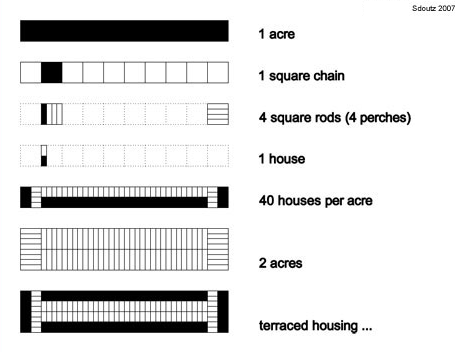
Img. _02 The Old English Measures diagram: English units and the concept of terraced housing. The usage of 'square chain' and 'square rod' may well be metricism [metrication] on my behalf.
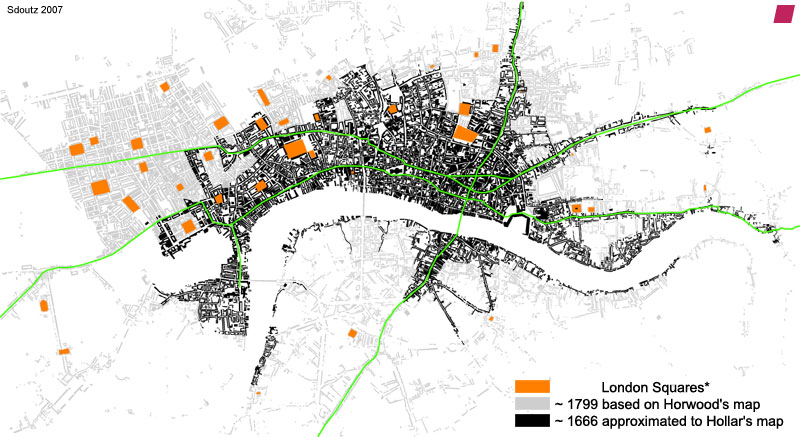
Img. _03 London Squares by 1799 according to Horwood's map of 1792 – 1799. The shaded area indicates London’s likely scale in 1666 approximated to Hollar's maps.
- Sdoutz 2010
11
To 'metropolize' [… named after Nicholas Metropolis] refers to computation [making sense] of data by iterative approximation based on probabilities of acceptance, or likewise: 'going urban'.
- IN:
'Kultur des Eigentums Reihe: Bibliothek des Eigentums, Band 3' edited by Schwäbisch Hall-Stiftung, Otto Depenheuer, compiled by Michael Stürmer and Roland Vogelmann, published by Springer-Verlag Berlin Heidelberg 2006
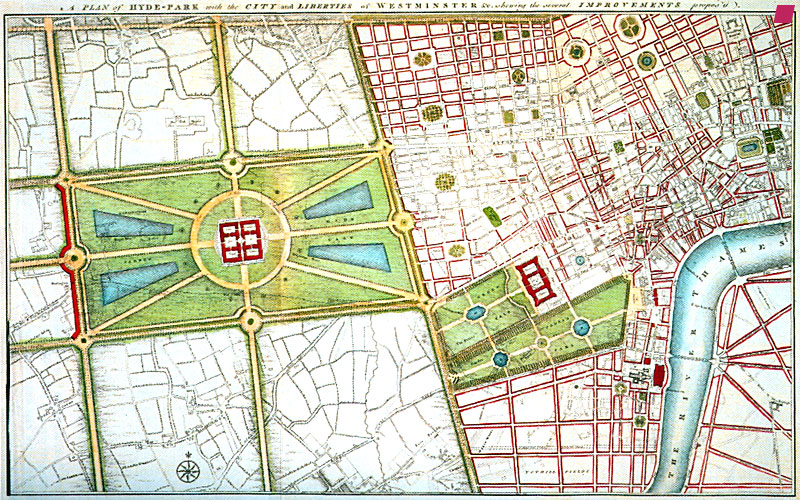
Img. _04 (page 214) "Stadtpläne" by Vittorio Magnago Lamppugnani (15 historic urban concepts from: "Das Modell der Stadt. Bausteine zu einer Ideengeschichte des Städtebaus 1750-2000" ETH Zürich)
Label: "A Plan of Hide-Park with the City and the Liberties of Westminster &c. showing the several Improvements proposed"
John Gwynn, "London and Westminster Improved, Illustrated by Plans. To which is prefixed, A Discourse on Publick Magnificence; […]", London 1766 (handcolored engraving) ETH Library, Zürich
http://photos1.blogger.com/ […]
http://www.biblio.com/
http://www.library.otago.ac.nz/ 2 […]
http://www.ethbib.ethz.ch/
http://books.google.de/
- 10 Some
urban developments in the 17th and 18th century, except layouts according to 'Leyes de Indias' (Laws of the Indies).
(true google urbanism)
Freudenstadt […] 1601 (plans by Heinrich Schickhardt, reconstructed after WWII)
Geoposition: +48° 27' 49.84", +8° 24' 40.74"
Glückstadt […] 1601 plan of 1724 […]
Geoposition: +53° 47' 17.24", +9° 25' 26.50"
Mannheim […] 1606 undated plan […]
Geoposition: +49° 29' 2.52", +8° 28' 32.35"
Amsterdam [1612, …] (Grachtengordel) 1607 (until the 1690s) [~1776] [more maps …]
Geoposition: +52° 22' 21.59", +4° 53' 9.28"
Henripolis […] urban development project around 1625
Versailles's politically motivated axiality formaly arranged by André Le Nôtre from 1662 onwards.
Plan of palace and park by Delagrive, 1746 depictied by Matthaeus Seutter,
1730 […]
Geoposition: +48° 48' 15.49", +2° 7' 19.98"
Plans for the rebuilding of London after the great fire of 1666 by
Christopher Wren (submitted 11th September 1666)large (reconstruction by John Gwynn
1749), and reproduced in 1773, 18th-Century copy.
John Evelyn 1st […] plan (actually engraved 1777, 1773)
Evelyn's 1st design (top) submitted 13th of September compared to Evelyn's 2nd design (bottom), and Evelyn's3rd (top) compared to Wren's plan (bottom) from Vetusta Monumenta 1789.
Robert Hooke's plan (inset 2) also reprinted by Jacob Venckel, 1667 (Anonymous 1667) and Marcus Willemsz Doornick 1666 (inset) and 1670 printed in Germany.
Valentine Knight's plan (consisted only of a description on a large printed broadside dated September 20th 1666) 1750
and zoomable. […]
[Attribution of schemes according to Rasmussen! Dates according to online sources. There seems to be confusion on the web, distinguishing Evelyn's and Wren's project …]
And there were 2 projects (probably the first design according to description) submitted by Richard Newcourt (the elder)
and one by Peter Mills. ['Lost' … ?]
William Penn's Philadelphia 1681 (plan […] by Thomas Holme from 1683) total map from 1687
Geoposition: +39° 57' 9.18", -75° 9' 53.16"
1699-1703 Neuf-Brisach […] by Sébastien Le Prestre de Vauban, extension plan undated […]
Geoposition: +48° 1' 3.88", +7° 31' 42.02"
Masterplans for St. Petersburg by Domenico Trezzini and Jean-Baptiste Alexandre Le Blond
from 1717. Plan from 1731 […] (by Johann Baptistus Homann)
Geoposition: +59° 56' 20.54", +30° 18' 56.83"
Karlsruhe 1715, copperplate prints 1721 (by Heinrich Schwarz) and 1737 […]
Geoposition: +49° 0' 39.51", +8° 24' 14.88"
1733 Oglethorpe's Savannah […] Georgia US (according to Peter Gordon), plans dating 1770, 1777 […], 1796 […] and later, and her squares
Geoposition: +32° 4' 38.94", -81° 5' 28.33"
Rebuilding of Lissabon after the 1755 earthquake according to the plans of Sebastião José de Carvalho e Melo.
Geoposition: +38° 42' 37.03", -9° 8' 15.44"
Kingston, Ontario 1673 (town plot of 1783, map dated 1790 currently lost in www…)
+
Edinburgh, New Town 1766 competition design by James Craig
Geoposition: +55° 57' 11.04", -3° 12' 2.12"
Arc-et-Senans […] 1773-1779
Geoposition: +47° 1' 59.28", +5° 46' 39.39"
Kaskinen 1785, plan […] by Carl Johan Cronstedt 1767
Geoposition: +62° 22' 55.78", +21° 13' 47.75"
Land Ordinance of 1785 (USA)
French revolution 1789
Peter (Pierre) Charles L'Enfant, basic plan […] for Washington, D.C. in 1791 and the revised plan by Andrew Ellicott one year later.
Geoposition: +38° 53' 55.26", -77° 2' 11.93"
- IN:
ARCH+ 209, Zeitschrift für Architektur und Städtebau, December 2012 http://www.archplus.net/
12 'Besitz und Besessenheit - Strukturen des Grundeigentums in London [Property and possession - structures of real-estate in London]' by Nick Beech and Amy Thomas, published in German, translated by Nikolaus G. Schneider [pages 52-59]
PDF
» 1066 führte William der Eroberer in England einen radikalen Rechtstitel ein, der die Verschmelzung von territorialer Souveränität und privatem Anrecht am Land vorsieht und sich rechtlich bis heute erhalten hat. Faktisch bedeutet es, dass niemand außer der Krone "Eigentum" an Grund und Boden haben kann. Dennoch scheiterten nach dem Großen Brand von 1666 alle Pläne für einen Neuaufbau Londons an den Interessen der größtenteils aus Kaufleuten bestehenden Grundbesitzer der City, die sich weigerten, sich der Autorität der Krone zu unterwerfen. Dieser augenscheinliche Widerspruch löst sich auf, wenn man sich die unterschiedlichen Konzepte von Eigentum und Besitz des common law, also des im gesamten angloamerikanischen Raum üblichen richterrechtlichen Gewohnheitsrechts, und des civil law, des auf dem römischen Recht basierend Zivilrechts, vor Augen hält. […]
Da nach dieser feudalen Struktur niemand außer der Krone "Eigentum" an Land beanspruchen konnte, führte man die Hilfskonstruktion des estate ein, eines für einen gewissen Zeitraum geltenden Rechtstitels an Grundbesitz. Die Einführung einer zeitlichen Dimension in das Konzept des Grundbesitzes dehnte die Bandbreite übertragbarer Rechte erheblich aus. Zudem ermöglichte es den Handel mit zukünftigen Rechtsansprüchen in einer juristischen Gegenwart, das Binden und Abspalten distinkter Rechte an Land sowie die zeitliche Zerlegung des estate mittels der Verfügungsdauer: zum einen in Form von freehold, der mit seinen zeitlich unbegrenzten Eigentumsrechten dem deutschen Eigentumsbegriff am nächsten kommt, oder zum anderen in Form von leasehold, der zeitlich begrenzten Pacht, die in etwa dem deutschen Erbbaurecht entspricht. […] « (page 52, 53)
|









TOP
Social Networks