| |
- 29 a As an architect, I indulge in spatial metaphors, even to the extend of high jacking theory [back] to the spatial realm. So enjoy [observing] this [model].
Illustrating 'Observational Space' … (audience)
Sum of all [possible*] points of view = Volume of all [meaningful*] observations.
A spatial interpretation of 'meaning', for meaning [only] requires observation:
[accomplished by] DIFFERENCE from anything not making sense, hence remaining » ineffective autopoietically. «
[maintained via] REPETITION in oder to distinguish from chance [what is unobservable, indistinguishable white noise]. …
Assessed somehow stroboscopically: now, now and now... all observation is uniform VII.) 1
(and true). In order to assign such basic properties some reductions are in place:
- 'Simultaneity [Gleichzeitigkeit]'
a section in time, anything going on 'now'. see synchronicity I.) 32
- 'Temporal symmetry' requiring for 'now' to be the same scale throughout that section.
To begin with my 'observational space' is uniform, equidistant, homogenious, isotropic …
| Key to illustrations: |
My notation here depends on whether (complete) immersion in the 'observational space' is made explicit, or (for the sake of argument) a remote view, seemingly "outside" is assumed. |
| Img. _03 |
Img. _06 |
There are different "(under)standings" attributed to similar symbols and graphic representations by others, I prefer to transfer mine from descriptive geometry. |
+
x |
+
x |
"Point" of view; viewer's eye (marking one's blind spot X.) 30 ). A distinction; thus already an observation.
(x merely being a distorted 'referential cross-hair') |
| |
[ ] |
"Picture plane" framing that view; "image" of what's been observed, result of the very process.
left: depicted as an elevation plane.
right:
written as a logic container.
|
| |
┐
|
Mark of distinction (George Spencer Brown)
There is a conceptual affinity though:
[ ] = ┐
[┐] is
merely descriptive … |
| — |
→ |
Relation (not depicted when obvious) |
| + |
+ → [ ] |
Observing "blank" |
| + s |
+ → [something] |
Observing something (first-order observation) Img. _02 |
|
+ | + |
Two different points of view (not related, occurring at the same time, both independently true, for the 'Principle of Relativity' IX.) 44 can not apply. See below) |
+ + |
+ → +
+ → [+]
+ → [+ → [ ]] |
Observing a different point of view (second-order observation) Img. _02 |
| + + + |
+ → [+ → [+ → [ ]]] |
Recursiveness implied. Img. _03 |
|
 |
+° Self-observation; impossible according to Foerster's blind spot notion X.) 30 - thus rendered as a case of "false perspective" obvious by any shift (of perspective);
+° resolves as + → +
when "appropriating" a view …
or
+° = + → +'
+' being one's prior position / distinction as we prgress
It's time to discard simultaneity.
|
 |
|
| +◉ = |
+ |
→ [+' → [+'' → [ |
|
] ] ] |
|
|
| |
↑ |
|
|
|
|
for + … n |
+ ↔ +◉
Observers are systems XII.) 28 and systems observe. |
|
+ → [ [ …]' ] |
"Memory" VI.) 20 discards temporal symmetry.
Tracing past / present / future (self) observations figures typologies: Img. _03 Img. _04 … |
|
 |
Though:
Second-order observation may be truly indistinguishable from self-observation.
+ → + <> +°
+ → + <> + → +' (consider the gentleman with the bowler hat Img. _05)
Not observable by a shift of perspective unless inferring / assigning certain properties to space (observer / audience) as such. Img. _06
Which of course is equal to augmenting 'observational space' with a point of view from "where" such properties are observable - do make sense. |
In "reality" all of this is totally non-problematic. On the contrary: the more complex < intricate, entangled > complicated this 'observational space' is perceived / meaning is constructed, the more we seem to enjoy it. […]
Img. _03 The 'recursive universe' or observing 'Ouroboros', Franz Sdoutz 2010
Of course, observing the "monster" from a distance / new angle [behavioural view] will not save us from being devoured by its next frame(work), for technically (in keeping with 'Social Systems' VI.) ) there is no "outside" position, no view from an Archimedean point. VI.) 15 XIII.) 55
Img. _06 Sections through 'Observational Space' [observing observation] Franz Sdoutz 2011
You, observing me, observing / stating a spatial interpretation of 'meaning' by means of making / crafting (some) sense V.) 33 [that is].
Both visualisations (left and right)
are of course the same geometry merely 'cut open' in different ways …
32 Dealing with 'meaning' figured as space, establishes an interesting parallel to Carl Gustav Jung's notion of 'synchronicity' relating events by meaning (proximity) instead of causality.
As an effect in 'space' this notion would render as:
[
+ → [[s] - [s*]] ] as "linking" elements (+, →, s, [ ], …) coinciding in / constituting a [ ] from any + .
or (when non-simultaneity or temporal a-symmetry is granted / considered):
+ → [s] followed by +' → [s*] thus relating s - s*
which is the same as +'' → [+ → [s] | +' → [s*]] where +'' is observing / reflecting on prior perspectives + | +'
12 a Cartoon characters are no different from other abstract models. 'Systems' are [BEING] distinguished from (their) surroundings [by someone]. Thus both Patrick and his rock are systems! see also II.) 11
Essentially (what this boils down to is) "believing" in systems, autopoiesis, society, global warming, gravity …
Of course NOT believing in "gravity" will not keep you from falling – it merely allows for different rationalisations / frameworks (of the very fact). [# Higgs Field]
- Img. _01 'Patrick Star' and 'SpongeBob SquarePants' in 'Bikini Bottom'. Merchandise image from the television series 'SpongeBob SquarePants', aired in 1999 on Nickelodeon. © 2001 Viacom International Inc. Produced by C&D Visionary Inc. http://www.nick.com/spongebob-squarepants/
9 Created by Stephen Hillenburg [according to http://en.wikipedia.org) a marine biologist.
10 'Patrick Star', a starfish, lives under a rock.
His best friend 'SpongeBob SquarePants' is a sea sponge. He lives in a pineapple next to Patrick in the underwater city (suburbia) of 'Bikini Bottom'.
11
[Patrick Star introducing Rocky] » Hey Spongebob, check out my new snail. «
[SpongeBob SquarePants] » Patrick, your snail is a rock. «
[Patrick Star] » Yeah thanks, I know. He's got nerves of steel. «
[time code 3:17 until 3:27]
And a bit later ostentatiously:
[Patrick Star] » … My snail. «
[Squidward Tentacles to Patrick] » Patrick, that's a rock. «
[Patrick Star] » Yeah thanks, I know. He's got nerves of steel. «
[time code 4:11 until 4:16]
From the episode: 'The Great Snail Race' Season 3, aired on January 24th 2003. Online video from http://sefruan.com/
[Details according to http://spongebob.wikia.com/]
- 'The Hitchhiker's Guide to the Galaxy' by Douglas Adams 1978 - 2001
'Life, the Universe and Everything' http://books.google.com/ PDF
Broadcast in September 2004 on BBC Radio 4 [and online] as 'The Tertiary Phase'
3 » […] You should be more
mattresslike. We live quiet retired lives in the swamp, where we
are content to flollop and vollue and regard the wetness in a
fairly floopy manner. Some of us are killed, but all of us are
called Zem, so we never know which and globbering is thus kept to
a minimum. […] «
Mattress conversing with Marvin the Paranoid Android [Chapter 9] http://www.angelfire.com/ 2
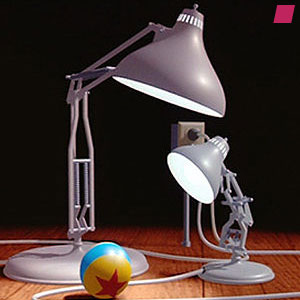
- Img. _02 Still from the short animation film 'Luxo Jr.' by Pixar Animation Studios, 1986 http://www.pixar.com/
8 In the lamp's case the distinctions it renders / observes, are its shadows: the difference between light and dark.
- My translations of Luhmann's German texts follows 'Social Systems' VI.) translated by John Bednarz, Jr. with Dirk Baecker.
33 Sinn (des Lebens) = meaning (of life)
Keeping its productive connotations 'Sinn' means 'Sense',
for sense [according to my my Styrian 'work ethos'] has to be established in the first place, whereas 'meaning' - [already] given VI.) 16 - conveniently may be conveyed / confered / applied.
Sinn (machen) = (to make, literally: to craft) sense see VIII.) 13
- ^ a b c d e 'Social Systems: Writing Science' by Niklas Luhmann, translated by John Bednarz, Jr. with Dirk Baecker, published by Stanford University Press, California 1995 [published first in German as 'Soziale Systeme: Grundriß einer allgemeinen Theorie' 1984, my paperback edition published 1987, both by Suhrkamp, Frankfurt am Main] http://books.google.at/ [German]
[The cover of 'Social Systems' features a set design sketch from the film 'Metropolis'.]
14 » The conceptualization of the social in terms of a meaning processing system of communication …. « [page xxiv, foreword by Eva M. Knodt]
15 a b » The Derridean paradox that "there is nothing outside the text," is not dissolved by systems theory but reemerges at the level of communication, where it can be reconceptualised in terms of the operational closure of a system that cannot operate beyond its own boundaries.
In order to observe society and to discriminate it from other types of systems, a boundary must be drawn from within society across which it can observe itself as if from the outside, but the construction of this outside is, and always remains, an operation of the system. "Whoever observes participates in this system – or he does not observe. There are no exempt positions." « [page xxxiii, foreword by Eva M. Knodt, quoting Niklas Luhmann from ‘Die Wissenschaft der Gesellschaft’, page 86, details according to Knodt]
27 a b c » […] Whatever is observed is observed by an observer, who cuts up reality in a certain way in order to make it observable. Whatever distinction is selected, others remain possible. Each cut highlights certain aspects of reality and obscures others. Reality as such, the unity of the observing system and its environment, the paradoxical sameness of difference, of inside and outside, remains inaccessible; it is what "one does not perceive when one perceives it," the "blind spot" that enables the system to observe but escapes observation. [referring to Luhmann, ‘Cognitive Program’ page 76 see also X.) 30 ] An outside observer can make this blind spot visible by distinguishing the observed system's distinction as a form that contains both of its sides, but in doing so, any such second-order observation must rely on its own blind spot and is bound to reproduce the paradox of observation at the operational level of its own distinction. […] « [page xxxiv, foreword by Eva M. Knodt, details according to Knodt]
16 » […] there remains the impression that meaning can be grasped as something given, something whose presence or absence can be determined. […] Meaning forces itself to change. […] « [page 63 - 64]
19 a » Finally we must note that history is constituted in the specific meaning dimension of time. By history we do not simply mean the factual sequence of events, according to which what is present is understood as the effect of past causes, or as the cause of future effects. […] History originates in the release from sequence. […] Accordingly, history is always the present past or the present future, always an abstention from pure sequence, and always a reduction of the freedom to have disjunctive access to everything past and everything future that is gained through this abstention. « [Meaning, VI, page 79]
20 a b c » The system reproduces itself only in the present and does not need memory [Gedächtnis] to do so. Under certain circumstances it can observe itself and ascribe a “memory,” or even a “bad memory,” to itself. […] But this does not alter the fact that something called memory exists only for an observer. […] « [Meaning, III, note 20, page 514]
21 a » One of the worst aspects of [our] language (and the entire presentation of systems theory in this book is inadequate, indeed misleading, because of it) is that predication is forced on the subjects of sentences; this suggests the idea, […] that we deal with "things," […] the primary object of systems theory is not the object (or kind of object) "system," but the difference between system and environment. « [Meaning, VI, page 77]
26 » We use the phrase "differentiate from" instead of "distinguish from" in order to avoid the implication of consciousness. […] But of course one can speak of "being able to distinguish" in the domain of social systems. « [System and Function, I, note 2, page 499]
47 a » We would like to call psychic systems that are observed by other psychic systems or by social systems persons. The concept of a personal system is thus one that involves an observer perspective, in which self-observation (so to speak, self-personalization) can be included. Because one can assume that any theory of psychic systems actualizes an observer perspective, one can speak of psychic and personal systems almost in the same sense. However, the conceptual distinction remains important because the concept of a person emphasizes relevance for an observer. We will not speak of the "psychicalization" but of the "personalization" of social systems in trying to express the dependence of communicational social systems' reproduction on the personal attributions of the participants. « [Double Contingency, II, page 109]
61 [page 412, Society and Interaction, III]
- 'Art as a Social System' by Niklas Luhmann, translated by Eva M. Knodt, published by Stanford University Press in 2000 [published first in German as 'Die Kunst der Gesellschaft' (The Art of Society / The Social System of Art) 1995, my paperback edition published 1997, both by Suhrkamp, Frankfurt am Main] http://books.google.at/ [German]
1 a [page 60 - 61, abridged]
Compare to my (improvised) translation, considering 'Social Systems' VI.) 26 just to keep perspective … See also Eva M. Knodt's own interpretation. VI.) 27 [Also compare to XII.) 28 ]
» Second-order observation distinguishes distinctions […] Thus, what can’t be observed by first-order observation becomes observable to second-order observation [namely observation as such] – providing that any second-order observer, as first-order observer on his part, cannot observe his observation nor himself observing. Such can be pointed out by a third-order observer, concluding in self-reference [autologically], that all of this is true for himself as well. «
» Beobachten zweiter Ordnung ist ein Unterscheiden von Unterscheidungen […] Für das Beobachten zweiter Ordnung wird mithin die Unbeobachtbarkeit des Beobachtens erster Ordnung beobachtbar - aber nur unter der Bedingung, daß nun der Beobachter zweiter Ordnung als Beobachter erster Ordnung seinerseits sein Beobachten und sich als Beobachter nicht beobachten kann. Darauf kann ein Beobachter dritter Ordnung hinweisen, der dann den autologischen Schluß zieht, daß all dies auch für ihn selbst gilt. « [Seite 101 - 103, gekürzt]
- 'Theory of Society' (Volume 1) by Niklas Luhmann, translated by Rhodes Barrett, published by Stanford University Press in 2012
[published first in German as 'Die Gesellschaft der Gesellschaft' (The Society of Society) by Suhrkamp, Frankfurt am Main, 1997, my paperback edition is from 1998]
http://www.sup.org/ [German]
Volume 1 [Chapter 1-3]
13 a b » Gesellschaft ist ein sinnkonstituierendes System. « [Seite 50] translates as:
» Society is a meaning-constituting system. « [page 21, literally, a matter of fact statement, compare to 'Social Systems' VI.) page 69, IV]
» Society as a system, establishes meaning. « [subject to other notions]
» Society as a system, makes sense. V.) « [ambiguous, though I do favour this version because it condenses my understanding of Luhmann’s essence]
» … the social in terms of a meaning processing system … « VI.) 14 [for "There is no such thing as society." Margaret Thatcher, 1987 </corny>]
Already at this trivial level language VI.) 21
prevails. see VI.) 15
62 » […] all communication is structurally coupled with consciousness. Without consciousness, communication is impossible. Communication is totally dependent (in every operation) on consciousness - if only because only consciousness and not communication itself can perceive sensorily, and neither oral nor written communication could function without perception. Moreover, communication, at least in its primary, oral form depends on reciprocity being established within the perceptual scope of the participating consciousness systems in the form of perception of being perceived. [...] « [page 56, 6. Operational Closure and Structural Couplings, Society as a Social System]
- 'Understanding Systems: Conversations on Epistemology and Ethics' by Heinz von Foerster and Bernhard Pörksen, translated by Karen Leube, published by Kluwer Academic/Plenum Publishers in 2002 [published first in German as 'Wahrheit ist die Erfindung eines Lügners : Gespräche für Skeptiker' (Truth is the Invention of a Liar. Conversations for Skeptics) by Carl-Auer-Systeme 1998, mine is the 3rd edition, published in 1999]
http://books.google.at/ [German]
[Page numbers refer to both Versions. Quoted from English translation.]
» B. P. [Bernhard Pörksen] So a solipsist imagines a solipsist who imagines a solipsist who imagines a solipsist. […]
H.F. [Heinz von Foerster] My friend Gordon Pask once came up with a beautiful sketch that illustrates this situation (Fig. 1). [Img. _05] You see a man wearing a bowler hat who claims to be alone. And this man imagines another man who is also wearing a bowler hat. He also imagines that the other man that he imagines doesn’t exist and is just a figment of his imagination. Now it could actually happen that the following situation might arise: A man who thinks along the lines of solipsism meets another man who thinks the same way.
B. P. Now the question arises as to who is right – the first or the second solipsist?
44 H.F. That's the crux of the matter. At this point in the conversation, I’d like to serve up the so-called principle of relativity, for the purpose of clarification. The principle of relativity says that a hypothesis that is true for A and for B can only be acceptable if it is also valid for A and B together. For the purpose of illustration, you might think of the well-known question as to whether it is the sun or the earth that is the center of the universe. It is plausible that there are beings on Venus and on Earth who would maintain the hypothesis that their respective planet is the center of the universe. As soon as I these Earthlings and Venusians meet, they will begin quarreling and a war will break out. Who is right? Who is in possession of the truth? In order to settle the fight, the principle of relativity can be used. You can demonstrate to the Earthlings and the Venusians that if they accept this principle, they cannot both be right. The principle of relativity is thus neither true nor false. The question is, then, whether you will choose to accept it or not. That is a decision that everyone has to decide for him or herself. The Venusians and the Earthlings could now decide to become heliocentrics and regard the sun as the center of the universe. If they chose to do so, they would enjoy living together and would even be able to exist alongside the Martians in peace and harmony. « [Seite 17, 18 / pages 28, 29]
Here Foerster utilises yet another [see also X.) 30 ] spatial metaphor [the solar-system] to advocate his Principle of Relativity: » If a Hypothesis holds separately for A, and it holds separately for B, the hypothesis is rejected, if it does not hold for A & B together. «
[from http://www.cybsoc.org/]
Basically rephrasing: "Two truths [deduced from the same believe] can never contradict each other."
But how do A and B "know" to share the same Hypothesis? How do Earthlings and Venusians grasp being part of the same system (having observed the SAME Sun from different perspectives), if not via the notion of heliocentrism (and its yearning for interplanetary travel) itself? The same applies to solipsists meeting in the street. The question "who is right?" only arises from an already "outside" position, capable of assigning the solipsistic argument (point of view) to separate (non-solipsistic) entities, thus causing them to contradict (each other).
Inconsistencies may also be inferred due to “mere” incompletes … falsifying / discrediting any hypothesis observable from “non-congruent” points of view. (Bell's theorem http://youtu.be/)
Img. _05 '… the gentleman with the bowler hat … [solipsist, inferred title]' drawing for Heinz von Foerster by Gordon Pask
Caption: » Fig.1 A man who claims that another person doesn't exist imagines another one who claims that another person doesn't exist (Illustration by Gordon Pask). « [Seite 18, page 29]
See also:
'From Stimulus To Symbol: The Economy Of Biological Computation' [PDF …]
'Perception of the Future and the Future of Perception' [PDF …]
'Time and Memory' [PDF ... 2]
- IN:
'Understanding Understanding: Essays on Cybernetics and Cognition' by Heinz von Foerster, published by Springer, 2003 http://books.google.at/ [PDF ...]
'On Self-Organizing Systems and Their Environments' [page 1 PDF]
'On Constructing a Reality' [page 211 PDF … 2 3]
30 a b c d » The Environment as We Perceive It Is Our Invention […]
The Blind Spot [Note: This key notion and its underpinning experiment are SPATIAL arguments, for even the rational of "(the) seeing (apparatus)" is inscribed in space, frequently illustrated by Foerster with SECTIONS through the human eye!]
Hold book with right hand, close left eye, and fixate star of Figure 1 with
right eye. Move book slowly back and forth along line of vision until at an
appropriate distance (from about 12 to 14 inches) round black spot disappears.
With star well focused, spot should remain invisible even if book is
slowly moved parallel to itself in any direction. [Do this online.]
This localized blindness is a direct consequence of the absence of photo
receptors (rods or cones) at that point of the retina, the "disk," where all
fibers leading from the eye’s light-sensitive surface converge to form the
optic nerve. Clearly, when the black spot is projected onto the disk, it cannot
be seen. Note that this localized blindness is not perceived as a dark blotch
in our visual field (seeing a dark blotch would imply "seeing"), but this
blindness is not perceived at all, that is, neither as something present, nor
as something absent: Whatever is perceived is perceived "blotchless." « [page 212]
» Note again
absence of perception of "absence of perception," and also the emergence
of perception through sensorimotor interaction. This prompts two
metaphors: Perceiving is doing, and If I don’t see I am blind, I am blind; but
if I see I am blind, I see. « [page 213]
» This is doubly difficult, because of […] a peculiar property of the logical structure of
the phenomenon "blind spot" on the other hand; and this is that we do not
perceive our blind spot by, for instance, seeing a black spot close to the
center of our visual field: we do not see that we have a blind spot. In other
words, we do not see that we do not see. This I will call a second order deficiency,
and the only way to overcome such deficiencies is with therapies of
second order. « [page 284, 'Cybernetics of Cybernetics' page 283]
'For Niklas Luhmann: "How Recursive is Communication?"' [page 305 PDF …]
- 'Urban Flotsam: Stirring the City' by CHORA (Raoul Bunschoten, Takuro Hoshino, Hélène Binet, and others) published by 010 Publishers, Rotterdam 2001 http://books.google.at/
'Alexandrov Seven Walks' [page 70 to 107]
Img. _04 Label: 'walk along' [page 86]
2 » Walk along
Finding something or someone to accompany is the first instance of using an observer in order to obtain a positive feedback. Yet it is a subtle and ambiguous means of interaction. « [page 81]
- ^ 'The Autopoiesis of Architecture, Vol.1: A New Framework for Architecture' by Patrik Schumacher, published by John Wiley & Sons Ltd., London, November 2010 [2011]
http://books.google.at/ [excerpt PDF]
4 a » The realization that a theory is designed rather than discovered opens up a whole new game, with a whole new freedom and burden. Instead of going round in circles with the received, crude apparatus of traditional architectural thinking, we might aim to construct a new, more sophisticated apparatus. And during this conceptual construction process we should be aware of our manifold theory design choices. « Page 6, prefixing a 'trail and error' commitment.
5 » This empirical base, […] remains crucial. «
To assume "proof" when observing / projecting compliance with "experience" in terms of assessing communication seems paradox, when [also assuming] communication is the only reality / experience we actually deal with / produce … See: system / environment ['axioms' page 19 onwards]
6 » Thus […] all theory is constrained by the need to maintain sufficient connectivity with the current reality of architecture as ongoing system of communications. «
… constituting communication of communication.
7 Promoting his book, Patrik Schumacher makes an explicit leadership claim. [see also http://www.aaschool.ac.uk/]
» No vital autopoietic communication system can afford to lag behind when it comes to updating its communicative sophistication in line with advancements achieved elsewhere in societal communication. « [page 8]
- Does "lagging behind" require direction?
- Suppose that architecture / design (already) constitutes a 'function system' different from the arts [page 25, 75] - why aren't architects calling the shots theoretically [in their own field]?
The explanation outlined on page 72 (2.1.1) merely sustains that (given the theory production of recent years) self-demarcation XII.) 24 of architecture by means of self-descriptions depends on "imported outside-descriptions re-written as self-description". Which could be interpreted in terms of architecture dissolving into other fields [media, design, philosophy, sociology, ecology, politics … page 94] in search of meaning / self-justification rather than establishing an "ultra-stable" boundary / raison d'être of its own.
- Why 'couple structurally' with sociology? [in terms of choice]
- Why infer teleonomy [in terms of a biological fallacy] into communication?
» Avant-garde styles […] start […], mature […] and end […] « and apparently are resurrected [as 'architectural research programmes'], when already deemed extinct. [Thesis 16, page 15, 277, 283, 294, 443]
… merely » testing for consistency « [page 17] XIII.) 55
22 » A sure empirical indicator for the factual, operational separation of art and architecture is the total absence of double careers. […] « [page 146]
Depending on one's expectations [career-wise] the usual suspects are:
Walter Pichler, James Turrell, Vito Acconci, Gordon Matta-Clark …
23 » […] architecture relies on its specific medium – the drawing – as much as the economy relies on its specific medium money. « [page 84]
Realizing of course that drawings equal money [and that is very true].
24 » Avant-garde vs. Mainstream « [pages 95 to 114, again deep in "artistic territory" …]
What is noteworthy [about this clearly "psychological construct"] is my personal observation that it is definitely not enough to be "avant-garde" (in terms of what one is doing / communicating) in order to BE avant-garde. It is vital to be recognised as such (to be differentiated from the rest, regardless of what one is doing / communicating) to qualify (for) that sub-system. Apparently self-demarcation (even via self-description by means of insisting on one's autonomy / one's belonging to …) doesn't count. Such (impertinence) is merely embarrassing.
What defines a social (sub) system is not self-description (alone) and please do try this at home, declare yourself avant-garde (by publishing a manifesto) …
Architectural avant-garde(s) are a concept to distinguish (deviations from ordinary). Of course such labelled / differentiated "deviations" thus define (what is) "ordinary". For an "avant-garde" to become mainstream (to be relabelled), different (new) deviations (defining that new ordinary) are prerequisite.
The term "avant-garde" - actually denotes:
- Professionals conspiring to joint communication in terms of self-demarcation (De Stijl, Dada)
- Individuals being distinguished for (assumed / inferred) joint criteria / communication by "mainstream authority" [in difference to ordinary]. (Constructivists, Cubists)
- Criteria being distinguished for no reason what so ever [apart from satisfying demand for difference / novelty] and attributed to individuals. (anything proclaimed by Philip Johnson)
It is only recognised avant-garde(s) we CAN observe. Such "relabelling" is NOT a requirement and rarely happens (within the deviant's lifetime). To BE avant-garde (before / without recognition) means to be unobservable for "mainstream", apart from being irritating …
What is true though for all (kinds of) semiotic-guerrillas [to apply a different framework], is the (conceptional) understanding, that one can’t transcend communication as such. VI.) 15
Most striking (apart from the delusions star-architects seem to enjoy) are the obvious economic implications / premises of Schumacher's "avant-garde" notion NOT made explicit [not even in systemic terms].
Remarkable in respect to the "taboo" of [explicit] second order observation / communication inherent. The agent provocateur (avant-gardist) must not disclose his purpose / function [in the autopoiesis of communication, cherish page 105]. In order to trigger the desired response all indications of careful consideration must be obscured.
To concede one's awareness (of the mechanisms at work) will result in indifference. [A condition steering "(a)vanguardists" share with leading politicians.]
One could come up with [alternative] metaphors of swarm-behaviour, where individuals dissect and the swarm will according to certain parameters change its [dis]course (follow or ignore runaways with serious implications for those individuals). Of course such [biological] transfer is inappropriate </ironic> in the context of 'Social Systems' VI.) (as a philosophical concept).
17 In my view Luhmann’s theory should not be argued in historic terms [in contrast to his own conduct].
For a) 'Social Systems' VI.) are difficult to apply to "ages" when (presumably) neither "social" nor "systems" (would have) made any sense …
and for b) the theory already takes into account that "history" VI.) 19 is a mere projection (observation) originating in the present. Strictly speaking there are no historical "facts", apart from their (current) interpretation [which is based on "remembrance" VI.) 20 , imprints of prior communications - result of (and resulting in) the ongoing autopoiesis of communication].
(An apparent example for how the past is subject to projection / concepts applied is the scientific perception of the Maya culture before and after deciphering its written records.)
Reinterpreting / retelling history is necessary in order to retain sense, and actually adds (new) meaning [to the "facts" as well as to the theories applied]. Such well established procedures appear misplaced though, when the "past" needs to be diminished in order to sustain one's theoretical framework.
» […] architecture is constituted by virtue of architectural theory. That is why the theory of architectural autopoiesis insists that architecture proper only begins with the Renaissance. […] « [page 36]
Assuming that a) there was no autonomous discourse before [the cultural expression we term Renaissance in accordance with 19th century communications]
and b) that the little there was had no impact (spurred no further discourse == had no autopoietic consequences) trying of course to maintain the perception that the celebrated Renaissance protagonists [page 81] had to invent everything from scratch …
The difference between "Gothic" and "Renaissance" (in terms of architectural discourse) is Gutenberg’s printing press. [as conceded on page 52 and 82]
To deduce from shifting media that early buildings lacked theory [then 'coupled structurally' with theology …] and therefore do not qualify as "architecture" within the axioms of an autopoietic theory, entirely misses the point of » communication via physical artefacts and buildings. « [Exposing deliberate demarcations disguised as systemically induced though. page 11]
» […] although architects […] of the great cathedrals were recognized and respected […] no names were preserved within the ongoing architectural discourse. In contrast, Alberti, Bramante and Palladio are still alive […] « [page 36; See some gothic masters and for the 'parametric' in 'gothic' see Lars Spuybroek 2 3 5]
If being an architect means to be at the centre of attention [being renowned] and architectural discourse implies "promoting a star-system" [page 100], then there’s something wrong. Not so much with a theory that describes / predicts such phenomena but with the conclusion that such is inevitable and hence desirable.
25
» Architecture is a systematic communication process that communicates (about) design decisions. These design decisions risk determining aspects of an (otherwise) uncertain future. « [page 197]
» However, the unpredictability of the future is only relative, not absolute. We are still able to chart general tendencies […] « [page 128]
Reference to [Sir] Karl Popper [from an explicit Marxist background] figures the present future [of architecture] no less erratic than its present past, VI.) 19 if it wasn’t for that subliminal notion of evolutionary progress …
28 a b » 3.1.2. Third Order Observation
All function systems […] observe themselves. « [page 182]
Systems observe systems. I.) 29 Niklas Luhmann conceives people (human beings) VI.) 47 as biological / psychic systems … » as parts of societal environment […] especially relevant for the formation of social systems [but] no longer the measure of society. «
['Social Systems' VI.) , Interpenetration, I, page 210, 212 and The Individuality of Psychic Systems, I, page 255]
In this sense 'system' [always] involves people.
Thus staging a symposium - involving people - not only cleverly celebrates / demonstrates 'The Autopoiesis of Architecture' XII.) [as a matter of fact] but also constitutes a self-observation of architecture (as far as the AA - location and general framework of the event - was concerned).
'Debating Fundamentals: Probing the Autopoiesis of Architecture' [Symposium, 11.03.2011, AA School of Architecture, London] was a swift trail, and the verdict inferred surprising:
According to his peers Patrick Schumacher's [least] achievement (like with all texts on Architecture before) is the distinction of what's in and what's out. [Crudely paraphrasing Mark Cousins.]
In architecture such is always equivalent to WHO’s in or out. [It’s all about that list really.] </austrian>
» … "All the people want to know is who are the good guys and who are the bad guys, and this is what we are going to tell them." … « [Quoted in 'Social Systems' VI.) , Interpenetration, end of VII, page 240, no reference given.]
18
Résumé: of Volume 1 ['A New Framework for Architecture' XII.) ]
The concept of autopoiesis requires [in order to be observed] historicity XII.) 17 (an awareness of the former VI.) 20 ), consequently antecedent [theoretical] 'achievements' aren’t rendered negligible.
Embedding 'The Autopoiesis of Architecture' in an already (well) established theoretical framework thus makes sense. German sociologist Niklas Luhmann provides that context. XII.) 63 In a discourse dominated by (French) philosophy, not an obvious choice though. 'The Architecture / Design of Society' - a treatment according to Patrik Schumacher "missing" from Luhmann’s famous sequence of society’s functional subsystems - apparently left an assignment waiting to be accomplished. [page 75, note 7]
» The Autopoiesis of Architecture might therefore be read as continuing the series, as an extension of Luhmann’s work with respect to the domain of architecture. […] The degree of intellectual dependence of the work presented here is nevertheless considerable. « [page 13]
Architectural theory [in particular] is about reaching an audience [beyond space]. In order to make that desired impact, connectivity is prerequisite. XII.) 6 Thus 'The Autopoiesis of Architecture' documents [a consideration of] contemporary believes I.) 12 in architecture.
Issues like weather there actually is "social evolution" [in terms of an adequately sustainable scientific assumption], or weather the "concept of autopoiesis" is applicable [at all], from an architectural perspective are irrelevant. Such criticism [directed at Luhmann] bares structural "design weaknesses" XII.) 4 though, inevitably leading to the question, why Patrik Schumacher chose to design his theory in [that] style?
» The ambition of the theory of architectural autopoiesis is to attract the kind of expert following that Luhmann has […] « [page 55]
[…]
Of course it’s nice to have [the sensation of] state of the art tools (practical and theoretical ones) and the [peer] pressure to apply the most advanced ["software" in both respects] will undoubtedly continue (as long as marketable). In this context, shifting focus towards 'communication' actually makes a difference, for this book is NOT about [making] architecture, it's about recognition [processes on the level of societal communication], observing / understanding architecture only in these terms.
[Second (April 2012) and third (May 2014) reading of Volume 1 due to Volume 2] see File Log
42 [page 365, 5.1 Architecture as Societal Function, Thesis 21]
46 » [...] By being differentiated and operationally closed off from its environment, a system can observe its environment. An observation is an operation that entails the moments of distinction and indication. A distinction slices the world and severs a point or domain of focus. This cut always produces a form with two sides, with a marked state on the one side and an unmarked state on the other side. The distinction is the primary operation while the indication signals which side of the form to connect to with further operations, ie, with further distinctions and indications. The unmarked state, as complementary other side of the form, is implicitly carried along. Therefore each observation implies a particular world as the unity of the difference of what is being distinguished. Any determinate distinction presupposes a certain conceptual field or horizon within which it is set. This presupposition is called the unity of the difference because it is what is shared by that which is distinguished. This unity of the difference is the inevitable blind spot [compare to X.) 30 ] of the observation that can only be revealed by another, new distinction that will have its own blind spot in turn. [see VI.) 27 ]
All observation is specific to an observer or observing system that is constituted by its own specific set of distinctions through which it observes its environment, and itself. Autopoietic systems observe their world (and thus construct their environment) on the basis of highly selective, narrow and specific points of contact, rooted in their internal constitution. [...] « [page 19 - 20, 0.5 The Premises Imported from Social Systems Theory, Introduction]
Compare to Andreas Philippopoulos-Mihalopoulos' critical account of Luhmann's core concept. [00:05:14]
58 a Note 35 on page 20 [suposingly] elucidates this axiomatic passage: » One might illustrate this point by thinking of a submarine [system] that observes and navigates its environment [sea] by a very specific set of instruments that produce a very narrow and abstract form of information. « This system does not "perceive" wetness (or anything for that matter). It (re)constructs a reference; [for instance] the terrain from detected sound[reflections]. Hence irritated by thermoclines (reflecting like solids) but unaware of all things jelly(fish) ...
Observation is not simply sounding [I'm sucking this metaphor] but to attribute concepts, forms, terms to distinguished echoes.
63 a b » The Autopoiesis of Architecture uses Niklas Luhmann’s social systems theory as guidance to construct this architectural theory as a theory of architectural communication within an autonomous, specialized communicative subsystem evolving within the overarching system of societal communications. Luhmann‘s theory opens an impressive comparative horizon encompassing many specialized domains of communication. The theory of architectural autopoiesis uses this impressive panorama for strategic excursions beyond the horizon of architectural concerns. The purpose of these excursions is to receive clues about the potential conceptualization of architecture from Luhmann‘s analysis of the communication structures of other, comparable discourses. These excursions do not leave architecture behind. Neither do they dissolve the disciplinary boundary of architecture. Rather, they teach architecture new ways of seeing itself. « [page 10, 0.2 A Unified Theory of Architecture]
- ^ 'The Autopoiesis of Architecture, Vol.2: A New Agenda for Architecture' by Patrik Schumacher, [paperback edition] published by John Wiley & Sons Ltd., London, [March/April] 2012
http://books.google.at/
http://youtu.be/ [Harvard lecture by Patrik Schumacher in February 2012, promoting Volume 2]
40 Volume 2 starts somewhat disappointingly by emphasising restrictions to » The
Task of Architecture « in terms of communication and scope:
» […] identifies architecture’s societal function as the innovative framing of social interaction. Interaction is defined as communication between participants who are physically present, […]. All social interactions take place in designed spaces filled with designed artefacts. […] Architectural artefacts frame virtually all social communication systems, with the exception of those systems that exclusively reproduce outside the interaction between physically present participants. […] All architectural communications, as well as all communications of all the design disciplines, are communications in the medium of space. […] « [page 5]
For (self)evidence that "presence" is NOT a requirement (in order to establish communication) see Déjà vu.
Literally (back) on stage, Schumacher reinstates the unity of (inter)action, place and time » […] Architectural spaces […] are priming the participants of an ensuing communicative encounter by setting the scene, by pre-constraining the range of possible communicative scenarios and by conjuring up anticipations about what is likely to be expected from the participants. « XII.) 42
[# Scena comica]
41 » […] Only the distinction of form vs function allows the framing of social interaction – a necessary dimension of all social evolution – to become a subject of critique and innovation. The task of architecture can thus be cast in terms of architecture’s lead-distinction: to give form to function. […] « [page 6]
No! (If only it were that simple …) The task of architecture, of all (societal) endeavours is to make sense (to infer meaning) of what is - or seems to be. see VIII.) 13 Of course Patrik Schumacher (in)advertently does precisely that: making sense of his practice (architecture, theory, us all) by understating in terms.
43 For my comments on 'Space Syntax' featured on page 112 [ » 6.4.5 Space Syntax: Concepts and Tools for Analysis « ] and the (im)pertinence of "Primitive Huts" included as site-plans / diagrams on page 425 - 426 [ » 8.6 The Built Environment as Primordial Condition of Society « ] see Architectural Models and Inside and Outside in Architecture.
[Resuming first reading of Volume 2, May 2014] see File Log
45 If Google-book-search is deemed reliable, (from experience I know that it is not) due to occurrence of words in 'The Autopoiesis of Architecture': » Architecture is half observation. « [Simply because the terms "observer, observing, observation, observe" show up nearly 150 times in both volumes, next to 220 instances of "autopoiesis" and approximately 300 accounts of "architecture".] Despite the [rigged] miscalculation terminology does allocate significance. Hence my reluctance to realise that » Observer « [with Patrik Schumacher] implies [at least] two different concepts:
56 Volume 1 [inferring Luhmann]: A SYSTEM, which due to its capability to observe [indication by means of distinction] enables itself as an observer. VI.) 27 No observer can observe anything independent from IT [observing]. » All observation is specific to an observer or observing system that is constituted by its own specific set of distinctions through which it observes its environment, and itself. Autopoietic systems observe their world (and thus construct their environment) [...] « XII.) 46
"Observation" equals "distinction" after the fact: In order to realise something to be black, it needs discrimination from anything not black in the first place … "Observation" demands having drawn / created [such] distinctions.
Strictly in this sense "observation" is distinguished from [simply] "seeing", when Sherlock Holmes replies to Dr. Watson:
» [...] You see, but you do not observe. The distinction is clear. [...] « XVI.) 48 For Conan Doyle attributing concepts [like colour, tally ... regardless of eyesight] is different from mere input of visual signals. [Compare to: Heinz von Foerster PDF]
57 a Volume 2: "Observer" as physical entity; VI.) 47 co-inhabiting the "scene" as an object. Its privileged [points of] views are carefully staged on sites seemingly controlled by the architect (who somehow eludes that very scenario, but clearly appreciates the cinematic implications ...). » [...] There might be a zone of transition where the matter becomes ambiguous and thus prone to the experience of Gestalt-switches. [...] The reading of the transition zone might depend on the direction from which an observer enters the transitional scene. It is in such a situation that figural after-effects come into play. [...] « [page 157 / 6.7]
This actor / agent is anticipated to participate in parametric modes of production. "Calibrating" projects by virtue of virtual cameras in CAD programs XIII.) 53 ensure such aesthetic complicity. Vistas encompass space. Optical illusions and perceptual deficits [in a literal, non-metaphorical way] induce decorative effects XIV.) 49 and » visual sensations « XIII.) 54 (in)formed by Gestalt psychology.
» [...] The manipulation of lighting conditions, and shifts in the observer position might trigger dramatic shifts in the appearance and understanding of a surface or space. Patterns might be set up in such a way that key parameters become Gestalt-sensitive so that a small variation in a critical parameter [...] triggers a surprising Gestalt-switch. [...] At that stage we would be able to talk about dynamic, high performance ornaments. « XIV.) 50
Patrik Schumacher also elaborates motion-studies on how "territory" controls behaviour / movement / flow (and in that sense the framework for "observation" as spectacle ...) as seminal insight at the end of his talks on Volume 2 'A New Agenda for Architecture' where WE are considered "distracted spectators" to be "tricked" XVII.) 52 into aesthetic realisations (of architecture) by streamlining dérive: A spatial strategy of pre-emptive counter practice XV.) 51 - if you will. Simulations render mass(miss)behaviour accordingly. The Flâneur has become parametric (data).
See: 'Parametric Semiology', October 10, 2012, Southern California Institute of Architecture, L.A. http://sma.sciarc.edu/ [...]
http://www.youtube.com/ analogously ...
and: UCLA A.UD Lecture Series: November 18, 2013, London, second half starting 1:07:00 http://youtu.be/
and 'Parametric Order - Architectural Order via an Agent Based Parametric Semiology', London 2012 http://www.patrikschumacher.com/
59 Ever since his talks it’s decisive that Patrik Schumacher actually conceptualises perception [architecturally], not observation [even though he keeps using the term]. see XIII.) 55
This distinction may seem semantic but none the less imperative: observers have all the choices (yet to make); perceivers (who, due to their inherent passivity in English aren’t even grammatical subjects) can (if) only withdraw. » [...] the spectacle in relation to the active man appears in the fact that his own gestures [distinctions] are no longer his but those of another who represents them to him. « XVIII.) 60 Behind such trifle lurks ideology: "Observation" constructs reality – "perception" presupposes it.
And as Slavoj Žižek maintains with respect to ideology: regardless whether you actually believe (in it), it still works. http://www.youtube.com/
55 Why shift from observation to perception without rationalisation? </psychological> Some bitchy arguments:
- Inconsistency:
- (Unwitting) To apply theory is different from making architecture. Schumacher’s understanding of observation changed in 15 years writing his book(s). It either slipped the author’s attention or he considers it irrelevant.
- (Intentional) Apparently observation as distinction XIII.) 56 will not argue (any) style / code, observation as spectacle XIII.) 57 on the other hand already implies given sense(s): Perception is a well-established notion in architecture set to endorse parametricism (as style). Hence Schumacher’s theory is admittedly reverse engineered, this shift in meaning constitutes [de]fault by [theory] design. XII.) 4 To establish / apply such comprehensive understanding of observation still makes sense for obviously perception too does involve drawing distinctions …
- (Lost in translation) Simply a matter of interchanging observation [Beobachtung: active routine] with [sensory] perception [Wahrnehmung: passive process]. Note the different understandings in German and English Wikipedia entries. In his talk Patrik Schumacher substitutes "to see, to perceive" with "to observe" and "someone who simply looks at something, beholder" with "observer" possibly with intent but certainly beyond my understanding / comprehension. http://sma.sciarc.edu/ [from 01:20:00 ...]
http://www.youtube.com/ analogously ...
Again according to Google-book-search XIII.) 45 "perception" is used only 53 times in both volumes with additional 49 instances of "perceive, perceived, perceiving, perceives".
- Synthesis:
- (Interface) Observation as a collective [concept] denoting all aspects of system - environment interrelations. XII.) 58 Due to the term's usage. [I would have loved some intel on this.]
- (Zoom) Processing distinctions on an atomistic level, observation is entangled to scale complex perception. (Observers are systems and systems observe.) I.) XII.) 28 In order to realise its full implications we need to "zoom out", allow for conceptual range.
Such implies totality - an overall meaning by which any observation can be put into place perspectively - a second order argument. Quite literally any realisation (pre)requisites a different point of view. Since no totality - no zoom. I.) Perception differs from observation fundamentally not gradually. XIII.) 59
- Putting the cart before the horse:
- Schumacher's notion of observation may differ (substantially) from his referred paragons in aspects I might not have even grasped (in order to facilitate HIS Autopoiesis). For it is only his insistent claim of (merely) applying Luhmann’s theory to architecture XII.) 63 [exemplifying architecture as an autonomous 'function system' of society] XII.) 18 which invites any misreading(s) in the first place.
For Niklas Luhmann that is to say "perception" is merely sensorial input of raw data without processing compare to XII.) 58 [if such is biologically feasable at all].
» […] Perception is a less demanding form of acquiring information than communication. It makes possible information that does not depend on being selected and communicated as such. This provides a certain security against some sources of error, in particular against deception and psychically conditioned distortion. Evolutionarily, perception is the primary and most widespread mode of information, and only in a few cases is it condensed into communication. Perception is primarily a psychic acquisition of information […] « VI.) 61
» […] It is of significant importance to maintain this distinction between communication and perception, VIII.) 62 although, and precisely because communication provides ample means of ongoing perception. Initially perception remains a psychic incident without communicative existence. It will not readily connect within a communicative occurrence. One can neither confirm nor disprove, neither interrogate nor respond to what another has perceived. It remains sealed within consciousness and non-transparent to the system of communication as well as to any other consciousness. […] «
'Was ist Kommunikation?' [What is communication?] by Niklas Luhmann, translated by me, my emphasis http://www.michael-giesecke.de/
IN: 'Lebende Systeme: Wirklichkeitskonstruktionen in der Systemischen Therapie' edited by Fritz B. Simon, published by Springer 1988 http://www.isbnsearch.org/
- Does it matter?
- Systemically: YES; architecturally: NO.
As long as we follow Niklas Luhmann in terms of communication sensorial perception is irrelevant. It merely provides input. see above So regardless of Schumacher’s Gestalt psychology shenanigans, XIII.) 57 all architectural communication accomplished may differ substantially from - even contradict - everything intended ... Architects know such futility to be true.
- Fuck Luhmann's notion of communication XII.) 63 altogether ... PDF
» […] Still other theorists continue to believe in interpreting and reinterpreting the classics as a remedy for sociology's current crisis. Authors turn into classics when their analyses of society become outmoded. When that happens, one must invent a new reason for continuing to read their works. This reason is that one's fellow theorists are still reading them as well. Instead of dealing with contemporary social reality, these theorists interpret the past. In this way, living theorists allow the absent and dead classics to dominate the present and living theorists. In this situation, one can draw criticism simply for failing to cite some classical source in support for one's own observations. Interpreting the classics is actually a form of ritual deference. […] « ['"What Is the Case?" and "What Lies Behind It?" The Two
Sociologies and The Theory of Society'
by Niklas Luhmann, translated by Stephen Fuchs, published by the American Sociological Association
IN: Sociological Theory, Vol. 12, No. 2 (July 1994), page 126 - 139 PDF]
64 Precursors and prototypes: Cybernetics
-
Kenzo Tange: 'Function, Structure and Symbol' 1966; IN: 'Kenzo Tange 1946 - 1969: Architecture and Urban Design' edited by Udo Kultermann, published by Artemis Zürich: Verlag für Architektur 1970 and by Pall Mall Press 1970 (page 240 - 245) [Abridged German excerpt PDF]
- Gordon Pask: 'The Architectural Relevance of Cybernetics' published in 'Architectural Design' September 1969 (page 494 - 496) PDF
100 Hence "BIKINI BOTTOM" essentially argues "observation" my thoughts regarding "Architecture's Semiological Project" (according to Patrik Schumacher: Chapters 6.8 - 6.10) will shift to
» SYNTAX «.
53 » [...] Virtuoso articulation cannot be designed via abstract diagrams or 2D line-drawings. Thus the task of articulation, especially under the condition of complexity and radical innovation, calls for a significant expansion of the design media of the discipline. The designer needs the enhanced visual simulation capacities of 3D rendering and animation to calibrate the perceptual efficacy of the design.
The visual appearance of buildings and spaces matters enormously within architecture. Both architects and clients demonstrate their investment in appearances and aesthetic matters. The theory of architectural aotopoiesis shows why this investment is not a fetish or indulgence. [...]
« [page 141, 142 / 6.5 Articulation]
54 » [...] The evolved human mind constructs or calculates the world of stable objects from the ever-changing stream of sensory inputs. The input for this calculation comprises the coincidence and concatenation of ever-changing, fragmented, tactile encounters and visual sensations. The visual sensations are subject to perspective distortions as well as to continuously shifting conditions of visual overlap and reflections due to modulated conditions of light/shadow. The perspective distortions are regularly concatenated and correlated with the sense of bodily movement. Reflections and overlap are also correlated with the sense of bodily movement indicating the subject's shifting spatial position. [...] « [page 148 / 6.7]
- 'Parametric Patterns'
by Patrik Schumacher, London 2009, published in: AD Architectural Design – Patterns of Architecture, Vol 79, No 6, November/December 2009, details according to: http://www.patrikschumacher.com/
49 » [...] I am proposing the distinction between organization and articulation as the two central dimensions of the task of architectural design. [...] Articulation should facilitate orientation by making the spatial organization, and the social order within it, legible. Orientation also implies the steering of expectations about the social scenarios that might unfold within a space and about the conduct that is appropriate within the space. [...] « [my emphasis]
50 » [...] The following specific registers of surface articulation might be distinguished: relief, seaming, material, texture, colour, reflectivity, translucency. Potentially all of these registers should be not only utilized but choreographed via correlating scripts. Surface relief is of particular interest because it makes the surface sensitive to both changing light conditions and changing view angles.
In order to take these conditions into account parametric design must extend its attention beyond the consideration of object parameters to include ambient parameters and observer parameters. The systematic work with variable ambient and observer parameters enhances the sense of animation that can be achieved with respect to the articulation of architectural surfaces. The manipulation of lighting conditions, and shifts in the observer position might trigger dramatic shifts in the appearance and understanding of a surface or space. Patterns might be set up in such a way that key parameters become Gestalt-sensitive so that a small variation in a critical parameter – object, ambient or observer parameter – triggers a surprising Gestalt-switch. This design agenda has been referred to as parametric figuration. For architectural surface patterns to participate in this agenda a certain degree of surface depth is required. Parametric figuration is perhaps the most ambitious form of architectural articulation. To become really effective it would have to go beyond merely visual effects. The Gestalt-switches would have to be correlated with the changing events scenarios that would benefit from a shift in understanding and orientation. At that stage we would be able to talk about dynamic, high performance ornaments. « [my emphasis]
- 'The Practice of Everyday Life' by Michel de Certeau, translated by Steven Rendall published by University of California Press 1984 [published first 1980] http://www.isbnsearch.org/ http://books.google.at/ PDF
51 » [...] I resort to a distinction between tactics and strategies.
I call a "strategy" the calculus of force-relationships which becomes possible when a subject of will and power (a proprietor, an enterprise, a city, a scientific institution) can be isolated from an "environment." A strategy assumes a place that can be circumscribed as proper (propre) and thus serve as the basis for generating relations with an exterior distinct from it (competitors, adversaries, "clientèles," "targets," or "objects" of research). Political, economic, and scientific rationality has been constructed on this strategic model.
I call a "tactic," on the other hand, a calculus which cannot count on a "proper" (a spatial or institutional localization), nor thus on a borderline distinguishing the other as a visible totality. The place of a tactic belongs to the other. A tactic insinuates itself into the other’s place, fragmentarily, without taking it over in its entirety, without being able to keep it at a distance. It has at its disposal no base where it can capitalize on its advantages, prepare its expansions, and secure independence with respect to circumstances. The "proper" is a victory of space over time. On the contrary, because it does not have a place, a tactic depends on time - it is always on the watch for opportunities that must be seized "on the wing." Whatever it wins, it does not keep. It must constantly manipulate events in order to turn them into "opportunities." The weak must continually turn to their own ends forces alien to them. This is achieved in the propitious moments when they are able to combine heterogeneous elements (thus, in the supermarket, the housewife confronts heterogeneous and mobile data - what she has in the refrigerator, the tastes, appetites, and moods of her guests, the best buys and their possible combinations with what she already has on hand at home, etc.); the intellectual synthesis of these given elements takes the form, however, not of a discourse, but of the decision itself, the act and manner in which the opportunity is "seized." [...]
« [page xix, General Introduction]
- 'The Adventures of Sherlock Holmes' by [Sir] Arthur Conan Doyle, published by Dogma 2012 [published first 1891 in 'The Strand Magazine'] http://www.isbnsearch.org/ http://books.google.at/
48 » [...] I could not help laughing at the ease with which he explained his process of deduction. "When I hear you give your reasons," I remarked, "the thing always appears to me to be so ridiculously simple that I could easily do it myself, though at each successive instance of your reasoning I am baffled until you explain your process. And yet I believe that my eyes are as good as yours."
"Quite so," he answered, lighting a cigarette, and throwing himself down into an armchair. "You see, but you do not observe. The distinction is clear. For example, you have frequently seen the steps which lead up from the hall to this room."
"Frequently."
"How often?"
"Well, some hundreds of times."
"Then how many are there?"
"How many? I don't know."
"Quite so! You have not observed. And yet you have seen. That is just my point. Now, I know that there are seventeen steps, because I have both seen and observed. By the way, since you are interested in these little problems, and since you are good enough to chronicle one or two of my trifling experiences, you may be interested in this." He threw over a sheet of thick, pink-tinted notepaper which had been lying open upon the table. "It came by the last post," said he. "Read it aloud." [...]
« [Adventure I. A Scandal in Bohemia, page 3, my emphasis]
- 'The Work of Art in the Age of Mechanical Reproduction' [actually 'The Work of Art in the Age of Its Technological Reproducibility' though I'm not so certain about the difference between "technical" and "technological" in this context] by Walter Benjamin, published first 1936, transcribed by Andy Blunden 1998 http://www.egs.edu/ 2
PDF 2 PDF [other versions and translations]
52 » [...] From an alluring appearance or persuasive structure of sound the work of art of the Dadaists became an instrument of ballistics. It hit the spectator like a bullet, it happened to him, thus acquiring a tactile quality. It promoted a demand for the film, the distracting element of which is also primarily tactile, being based on changes of place and focus which periodically assail the spectator. Let us compare the screen on which a film unfolds with the canvas of a painting. The painting invites the spectator to contemplation; before it the spectator can abandon himself to his associations.
Before the movie frame he cannot do so. No sooner has his eye grasped a scene than it is already changed. It cannot be arrested. Duhamel [...] notes this circumstance as follows: "I can no longer think what I want to think. My thoughts have been replaced by moving images." The spectator’s process of association in view of these images is indeed interrupted by their constant, sudden change. This constitutes the shock effect of the film, which, like all shocks, should be cushioned by heightened presence of mind. By means of its technical structure, the film has taken the physical shock effect out of the wrappers [...] « [End of chapter XIV] https://www.youtube.com/ [00:41:01]
- ^ 'The Society of the Spectacle [La Société du Spectacle]' by Guy-Ernest Debord first published 1967 by Editions Buchet-Chastel Paris [the first English translation was published by Black & Red in 1970] http://library.nothingness.org/ [1983 edition]
60 » Chapter 1 "Separation Perfected" «
» 30
The alienation of the spectator to the profit of the contemplated object (which is the result of his own unconscious activity) is expressed in the following way: the more he contemplates the less he lives; the more he accepts recognizing himself in the dominant images of need, the less he understands his own existence and his own desires. The externality of the spectacle in relation to the active man appears in the fact that his own gestures are no longer his but those of another who represents them to him. This is why the spectator feels at home nowhere, because the spectacle is everywhere. [...] « [online]
- 'Beobachter unter sich: Eine Kulturtheorie [Observers amongst themselves: A theory of culture]' by Dirk Baecker, published first by Suhrkamp Verlag in April 2013
http://www.amazon.de/
http://www.dradio.de/ 'Der beobachtete Beobachter [The Observed Observer]'
Sociologist Dirk Baecker on a contemporary key term talking to Michael Köhler. Broadcast by Deutschlandfunk 28.07.2013 17:05 Duration 00:24:44 minutes
404 [Download my MP4 recording in rather poor quality.]
|








!['Ouroboros' [circular self referential observation of n-th order] Franz Sdoutz 2010](http://www.golden-dawn.com/goldendawn/UserFiles/EN/image/gallary/Alchem_pic_div/1-Ouroboros,%20Synesius.jpg "'Ouroboros' Franz Sdoutz 2010")
!['Alexandrov Seven Walks' from 'Urban Flotsam: Stirring the City' by CHORA (Raoul Bunschoten, Takuro Hoshino, Hélène Binet, and others) [page 86]](content/chora_walk_along_800.jpg "'Alexandrov Seven Walks' from 'Urban Flotsam: Stirring the City' by CHORA (Raoul Bunschoten, Takuro Hoshino, Hélène Binet, and others) [page 86]")
!['Observational Space' [observing observation] Franz Sdoutz 2011](content/observational_space_sdoutz_2011.gif "'Observational Space' [observing observation] Franz Sdoutz 2011")
!['… the gentleman with the bowler hat … [solipsist]' by Gordon Pask from 'Wahrheit ist die Erfindung eines Lügners : Gespräche für Skeptiker' by Heinz von Foerster and Bernhard Pörksen](content/gordon_pask_solipsist.gif "'… the gentleman with the bowler hat … [solipsist]' by Gordon Pask from 'Wahrheit ist die Erfindung eines Lügners : Gespräche für Skeptiker' by Heinz von Foerster and Bernhard Pörksen")


TOP
Social Networks