| |
- 0 Well, let's see about that …
- 'The Drawings of Frank Lloyd Wright' by Arthur Drexler, published by Bramhall House, New York in 1962
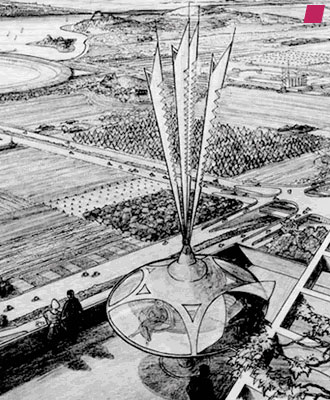
Img. _01 5825.003 perspective view [detail] of 'The Living City', published in 'The Living City' 1958 [page 181]
- 'Central Milton Keynes', A.D. Architectural Design 8/1974, published in 1974 VII.) 2
http://www.flickr.com/
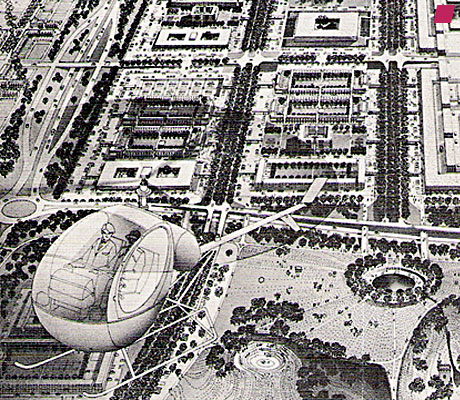
Img. _02 'Aerial view of Central Milton Keynes twenty years in the future' for the Milton Keynes Development Corporation by Helmut Jacoby.
"The image shows architectural sketches of the CMK area, as it might have looked in 1991. Campbell Park is at the bottom of the picture with Milton Keynes Central Station at the far end of Midsummer Boulevard." [http://flickr.com/]
One source identifies Helmut Jacoby’s 1990’s Milton Keynes as envisaged in 1973 …
- Bing Maps 2010 [Microsoft]
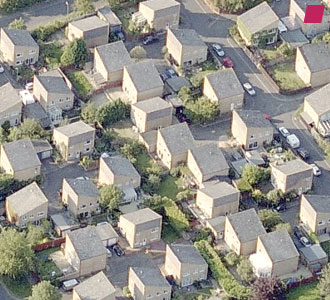
Img. _03 Ashfield, Milton Keynes from Microsoft Virtual Earth 2009 http://www.bing.com/
- 'Die Geschichte der Stadt [The History of the City]' by Leonardo Benevolo, Campus Verlag, Frankfurt am Main, Edition: 9, 2007 [first published 1975].
http://books.google.at/
Img. _04 Stantonbury 3 Complex [Ashfield], Milton Keynes [page 1001] Caption: » Abb. 1550-1554. Milton Keynes: zum Komplex Stantonbury 3 gehörende Wohnhäuser. « Drawing by [?]
- IN: 'Modern Architecture and the Critical Present: Kenneth Frampton', A.D. Architectural Design 52 7/8-1982, guest-edited by Kenneth Frampton, published in 1982,
» […] The main title of this chapter, 'Place, Production and Architecture' was a critical reference to Giedion's canonical history of 1941; for I remain convinced that the apparent antipathy between place and production is of more consequence for architecture today than any of the parallels which Giedion once saw as linking built form to supposedly scientific models of the universe. […] « [Introduction, page 4]
'Place, Production and Architecture: Towards a Critical Theory of Building' by Kenneth Frampton [page 28 to 45]
[chapter 4 of 'modern architecture: a critical history' 1980 edition, page 280 http://books.google.at/ preview]
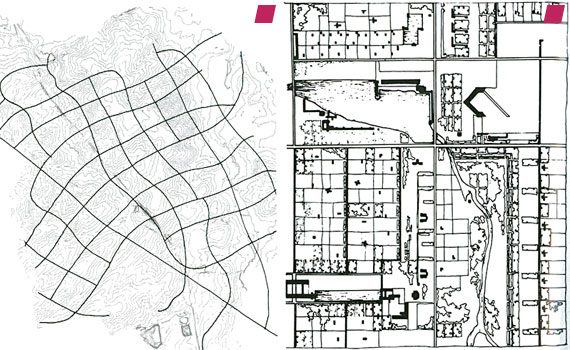
Img. _05 [page 32]
[left] caption: » 8 Milton Keynes, road grid and contours, 1972 «
[right] caption: » 9 Broadacre City, plan, Frank Lloyd Wright, 1932-58 « [detail showing 'SECTION A' as published in 1958]
1 » An equally indeterminate approach [of interdeterminacy VI.) 3 and optimum flexibility taken to extremes] was adopted in the 1972 design of the English New Town, Milton Keynes. This city, based on a somewhat irregular street grid, was apparently conceived as an instant Los Angeles to be laid over the agrarian landscape of Buckinghamshire. Its empty irregular network, configurated after the topography, was yet another exercise in indeterminacy pushed to absurdity. Despite the Neoclassicism of its Miesian shopping centre, its capacity to represent its municipal identity is still virtually non-existent. One has no notion of arrival here save for the graphic indication of the legal boundary, and for the casual visitor Milton Keynes seems nothing more than a rather random collection of more or less well-designed housing estates. One thinks by contrast of the orthogonal precision of Wright's Broadacre City, where, despite the relentless dispersal of the urban fabric, places would have acquired a certain definition by virtue of their orthogonal boundaries. Here, needless to say, what boundaries there are fail to correspond to any clearly perceivable order, and this is hardly surprising given that the structure of the town was influenced by the planning theories of Melvin Webber, whose slogan 'Non-Place Urban Realm' seems to have been adopted as a credo by the official architects of the plan, Llewelyn-Davis Weeks, Forestier-Walker and Bor. The fact that this slogan stemmed from Webber's commitment to the Kristaller-Losch [Walter Christaller, August Lösch] central place location theory - then as now, the most dynamic model available for the creation of optimum marketing conditions - could hardly have escaped either the architects or the City Corporation. This selection of an open-ended planning model in accordance with the hypothetical interests of a consumer society was surely a conscious choice. « [pages 32, 33]
3 The term 'interdeterminacy' here VI.) 1 seems to be synonymous to 'indeterminacy', for both denote notions of 'uncertainty' in terms of 'lacking structure' rather than 'individually shaped' or 'placed in-between' and it is only used [occurs] once …
- 'Milton Keynes: image and reality' by Terence Bendixson and John Platt, published by Granta Editions, Cambridge 1992 [reprinted 1998] http://books.google.at/
2 » For three years, starting in 1973, Architectural Design, then Britain's most avant-garde design magazine, was commissioned to devote entire issues to Milton Keynes. […] « [page 107] see III.)
- IN: 'Digital Cities' Architectural Design Vol 79, No 4 (July/August 2009), guest-edited by Neil Leach, published by Wiley http://eu.wiley.com/
'Parametricism: A New Global Style for Architecture and Urban Design' by Patrik Schumacher [pages 14 to 23]
online from: http://www.t12online.com/
Img. _07
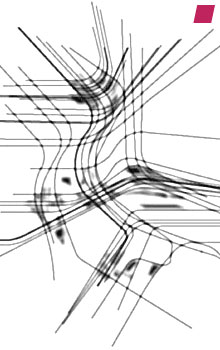
'Conceptual Lines and Hubs' One North Masterplan, Singapore, Singapore, 2001–2021 [The image reproduced here is taken from http://www.zaha-hadid.com/ and inverted by me. It was published in A.D. as its rotated mirror image … on page 17]
Caption: » Zaha Hadid Architects, One-North Masterplan, Singapore, 2003 […] This masterplan for a new mixed-used urban business district in Singapore was the first of a series of radical masterplans that led to the concept of parametric urbanism and then to the general concept of parametricism. «
- 'AF Gold Lectures: Geoff Shearcroft interviews Derek Walker'
or 'Summer Nights: Derek Walker
in conversation with Geoff Shearcroft',
curated by Ellis Woodman with the Architecture Foundation, recorded at BDP in London's Clerkenwell on July 25th 2007 AF_Gold_talk2.mp3 Audio MP3, [75.3 Mb] from
http://www.bdonline.co.uk/ {disallow cookies} and http://www.architecturefoundation.org.uk/]
Discussing [quite entertainingly] his notion of the 'Forest City' … Derek Walker [chief architect and planner to Milton Keynes from 1970 to 1976] reveals something extraordinary.
[time code 45:50]
[Geoff Shearcroft] » One of the first things Derek said to me about the landscape schemes that it was a damage limitation exercise. «
[Derek Walker] » It was. «
[Geoff Shearcroft] » … When private developers are left to their own, you have to cover it up. Is that your proposal? «
[Derek Walker] » … Well it was one of the proposals, because we knew it was [~] gonna happen [~] You know there is certain degree of lack of control in a democratic society. […] In a way one wants to go back - you know to the quality […] « [time code 46:40]
[~] … incomprehensible to me (non-native speaker)
Far from inferring any "royal longings" … , "democratic society" seems an ambivalent "founding narrative" for Milton Keynes though.
- 'The New New Town: What the past can teach the future', symposium organised by The Architecture Foundation and urbandrift, held on the 20th and 21st of February 2008 in London
http://www.newnewtown.com/
http://www.architecturefoundation.org.uk/
"Derek Walker discusses the challenges and successes of Milton Keynes in light of issues relating to [.] new [eco] towns." [an obituary]
http://www.newnewtown.com/
http://vimeo.com/
[time code 01:58]
[Derek Walker] » We are confronted especially in a democracy with the gradual erosion of whatever consensus there was on goals and priorities through to completion. « [time code 02:10]
[time code 04:00]
[Derek Walker] » … to change a diagram into a city. «
[time code 04:37]
[Derek Walker] » The rather dull typography of Milton Keynes required a very different character. ‚Forest City’ became a primary goal, looking to provide a city greener than the surrounding countryside. « [time code 04:50]
- 'The Architecture and Planning of Milton Keynes' by Derek Walker with an introduction by Steen Eiler Rasmussen, published by the Architectural Press, London 1982 http://books.google.com/
» Today we organise our social lives through the telephone, post box, private cars and public transport. Our lives are more influenced and informed by TV, radio and newspapers than by meetings in the street or chats over the garden fence. […]
[Melvin] Webber's ideas of a community based on voluntary association rather than propinquity are fundamental to the thinking behind the Plan - he could claim more than anyone to be the father of Milton Keynes. All the abstract statements about goals - freedom of movement, choice etc. - come into focus when viewed as part of a vision of a city which is an open matrix for selection, by the individual, of opportunities for social contact, recreation, education and the rest. « [page 8]
» The idea of building a ‘neighbourhood’, ‘village’ or ‘cluster’ as a functioning social unit is now properly discredited. « [page 10]
|







!['Stantonbury 3 Complex', Milton Keynes from 'Die Geschichte der Stadt [The History of the City]' by Leonardo Benevolo, Campus Verlag, Frankfurt am Main, Edition: 9, 2007 [page 1001]](content/ashfield_stantonbury_drawing.jpg "'Stantonbury 3 Complex', Milton Keynes from 'Die Geschichte der Stadt [The History of the City]' by Leonardo Benevolo, Campus Verlag, Frankfurt am Main, Edition: 9, 2007 [page 1001]")


TOP
Social Networks